
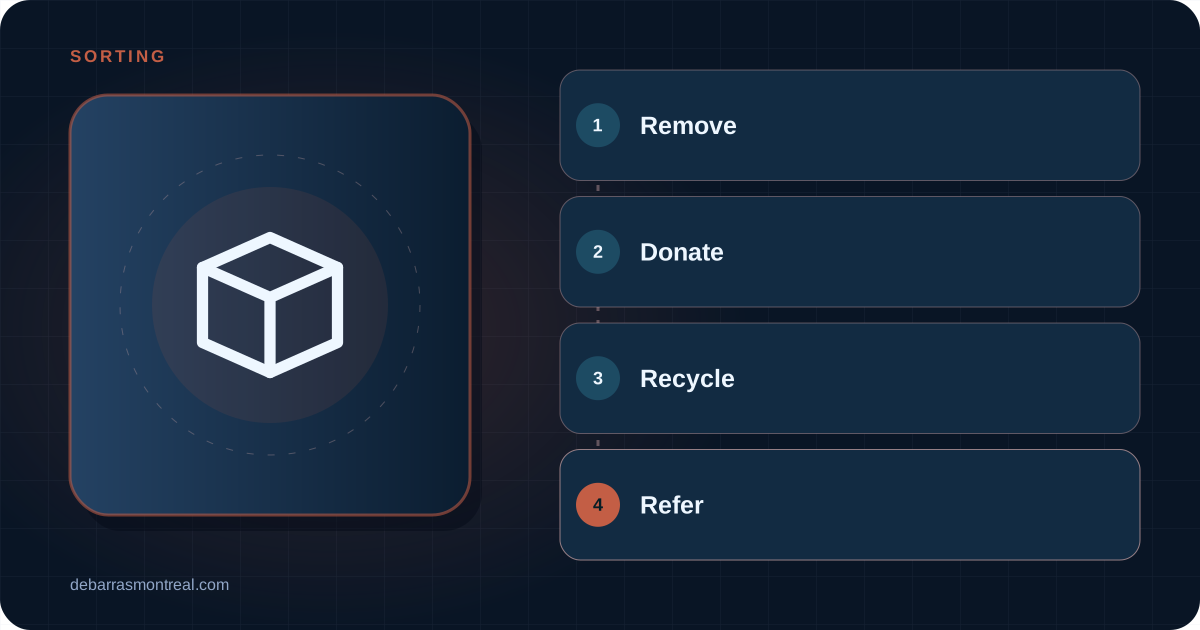
Quick answer: Put every item in one of four routes: remove (worn furniture and items), donate (items in good condition that an organization accepts), recycle (materials accepted at an ecocentre or by a recovery program) or refer (paint, solvents, batteries, propane, mercury bulbs and refrigerant appliances). Decide before the crew arrives, and keep hazardous materials apart.
A cleanout goes faster, with fewer surprises and less waste, when every item already has its route before the crew arrives. Four routes cover almost everything found in a house, an apartment or a garage.
Direct answer: four routes, decided in advance
Put each item in one route: remove, donate, recycle or refer. Worn furniture leaves with the clearout; items in good condition go to organizations that accept them; recyclable materials go to an ecocentre or their recovery program; hazardous household waste and refrigerant appliances need separate handling. Never mix the routes.
Key terms
- Hazardous household waste: household products such as paint, solvents, batteries and propane tanks.
- Reuse: an item keeps its purpose with someone else.
- Recovery program: a program or site that takes a material for recycling or reclamation.
The four routes
| Route | Examples | How |
|---|---|---|
| Remove | Worn furniture, mattresses, broken items | Private clearout, or bulky-item collection for individuals |
| Donate | Furniture and items in good condition | According to the organization's criteria |
| Recycle | Metal, cardboard, electronics | Ecocentre or recovery program |
| Refer | Paint, solvents, batteries, propane, mercury bulbs, refrigerant appliances | Ecocentre or partner drop-off for hazardous waste; qualified people for refrigerants |
What the City asks
The City of Montréal says hazardous household waste must never go in household waste or down the sewer. Residents can take it to an ecocentre, in watertight containers of 20 litres or less, and some products have partner drop-off points, such as paint and electronics. Medications go back to a pharmacy, and asbestos is not accepted.
Deciding before the crew arrives
- Mark each route with a sticker colour.
- Group items to refer in one safe place.
- Confirm donations before the day.
- Keep a list of what goes where.
To go further, see planning donations and reuse, special materials to keep apart and where appliances and electronics should go.
Next step
See house clearouts, then request a clearout quote.
Frequently asked questions
Can a private clearout take paint?
Generally not in an ordinary load; keep it apart and ask.
Will everything in good condition be donated?
No; it depends on the organizations' criteria.
What about medications found while sorting?
Take them back to a pharmacy.
What about propane tanks?
Keep them apart and follow the City's instructions for hazardous household waste.
Sources
Sources checked on November 12, 2026.